Walk into any Indian home, school, office, canteen, or community hall and you will find it sitting right there in plain sight. Sturdy, lightweight, easy to clean, and available in every colour imaginable. The humble plastic chair has quietly become one of the most dependable pieces of furniture that modern India relies upon every single day. Yet very few people stop to ask a rather fascinating question: how exactly does a plastic chair come to life?
At Jagdamba Polymers Limited, we have been answering that question through action since 1999. With over 25 years of experience manufacturing high-quality moulded plastic furniture and houseware from our ISO 9001:2015 certified facility in Balasore, Odisha, we understand the science, craftsmanship, and engineering that goes into every product we make. In this blog, we take you deep inside our manufacturing process to show you exactly what happens before a plastic chair, a plastic table, or a plastic storage container lands at your doorstep.
What is Injection Moulding?
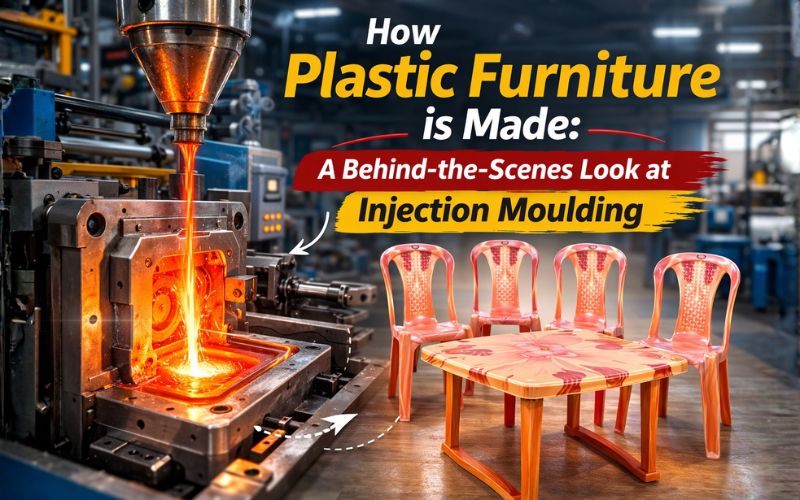
Injection moulding is a manufacturing process in which molten plastic material is injected under high pressure into a precisely engineered metal mould. Once the material cools and solidifies inside the mould, it takes on the exact shape of the cavity and is then ejected as a finished product or component. The process is extraordinarily versatile and is used across industries ranging from automotive and aerospace to consumer electronics and, of course, household goods.
For the plastic furniture and houseware industry, injection moulding is the gold standard. It is the reason why every modern plastic chair you purchase looks identical to the one next to it, feels equally sturdy, and maintains the same structural integrity whether it is the first unit off the production line or the ten thousandth. The process eliminates guesswork and replaces it with engineering precision.
The Raw Materials: Where Quality Begins
Before a single machine is switched on, the foundation of a great plastic product is already being laid through raw material selection. The most commonly used materials in plastic furniture manufacturing are Polypropylene (PP) and High-Density Polyethylene (HDPE). Both of these are thermoplastics, meaning they can be melted and reshaped without losing their core chemical properties, which also makes them recyclable.
Polypropylene (PP)
Polypropylene is the material of choice for most moulded furniture, including chairs, stools, and tables. It offers an excellent balance of rigidity, impact resistance, and flexibility. It is also resistant to heat, moisture, and most household chemicals, which is why it continues to perform well in Indian climates across extreme summers and monsoons. At Jagdamba Polymers, our plastic chairs and plastic stools are manufactured using carefully graded polypropylene that has been tested for load-bearing capacity and surface finish quality.
High-Density Polyethylene (HDPE)
HDPE is widely used in the production of containers, bins, and storage products. It is tougher and denser than standard polyethylene, making it ideal for products that must hold weight, resist impact, or come into contact with food substances. For our food-grade plastic storage containers and kitchen dustbins, only HDPE that meets food safety compliance standards is used. This is not incidental. Our facility is FSMS 22000:2005 (Food Safety Management System) certified, which means raw material traceability and safety are non-negotiable commitments.
Colourants and Additives
Raw plastic in its natural state is either colourless or a milky white. To achieve the vivid, consistent colours you see across our product range, masterbatch colourants are blended into the raw material before processing. These colourants are carefully formulated to be UV stable, meaning the colour does not fade when the product is used outdoors over extended periods. Stabilisers and anti-oxidant additives are also incorporated to extend product lifespan and resist degradation from heat and light exposure.
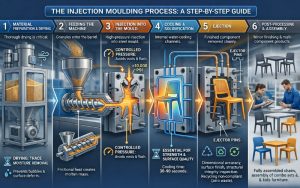
Step by Step: The Injection Moulding Process
Once the right raw materials are selected and prepared, the actual manufacturing process begins. Each stage is interconnected, and precision at every step is what separates a high-quality product from a mediocre one.
Step 1: Material Preparation and Drying
Plastic granules, also called resin pellets, are first thoroughly dried before entering the moulding machine. This is a critical step that many outside the industry overlook. Even trace moisture in the raw material can create bubbles or surface defects in the final product. Our raw material is dried in industrial hoppers at controlled temperatures before any production begins.
Step 2: Feeding the Injection Moulding Machine
The dried granules are fed into the hopper of the injection moulding machine. From the hopper, they travel into a heated barrel containing a rotating screw mechanism. As the screw turns, it moves the material forward while simultaneously applying frictional heat. By the time the material reaches the front of the barrel, it has been transformed into a homogeneous molten mass, ready for injection.
Step 3: Injection into the Mould
The molten plastic is now injected at high pressure, often exceeding 10,000 pounds per square inch, into the closed metal mould. The mould itself is a precision-engineered steel tool that has been designed by our engineering team to produce the exact geometry of the finished product. For a plastic chair, the mould accounts for every curve, rib, support structure, and surface texture that makes the chair both comfortable and strong.
The injection process must be managed carefully. Too little pressure and the mould will not fill completely, leaving voids. Too much pressure and the material may flash, meaning it escapes beyond the mould cavity and creates thin unwanted fins on the product. Our operators and automated control systems maintain exact parameters for every single production run.
Step 4: Cooling and Solidification
Once the mould is filled, the cooling phase begins. The mould is internally water-cooled through a network of channels that run through the steel tool. This controlled cooling is essential. If the product cools too quickly, internal stresses may develop, weakening the structure. If it cools too slowly, production efficiency is reduced and surface quality may suffer. The cooling time for a standard plastic chair typically ranges between 30 to 90 seconds depending on the wall thickness of the product.
Step 5: Ejection
Once the material has solidified sufficiently, the mould opens and ejector pins push the finished component out cleanly. The product is then inspected by our quality control team for dimensional accuracy, surface finish, and structural integrity. Pieces that do not meet our standards are not sent forward. They are returned to the raw material cycle and recycled, ensuring zero unnecessary waste.
Step 6: Post-Processing and Assembly
For most moulded furniture, the component that emerges from the injection moulding machine is already very close to the finished product. However, certain items require minor post-processing, such as removing gate marks (the point where molten plastic entered the mould), assembly of multi-component products, or surface treatment. Our table and chair combos and kids furniture sets undergo careful assembly and inspection before they are packaged and dispatched.
The Mould: The Heart of the Process
Of everything involved in injection moulding, the mould itself deserves particular attention. A mould is not simply a hollow cavity. It is a sophisticated engineering artefact that can cost anywhere from a few lakhs to several crores of rupees, depending on its complexity, and it must withstand hundreds of thousands of production cycles without losing dimensional accuracy.
At Jagdamba Polymers, our moulds are designed with the following critical considerations in mind:
- Gate design: The location and type of gate, which is the point where plastic enters the mould cavity, directly affects how the material flows and whether any visible marks remain on the finished product.
- Cooling channel layout: The configuration of cooling channels inside the mould determines how uniformly and efficiently the product solidifies.
- Draft angles: Every vertical surface in a mould must be slightly angled to allow the product to eject cleanly without scraping or sticking.
- Parting line placement: The line where the two halves of the mould meet must be positioned where it is least visible and least likely to create a structural weakness.
Good mould design is what gives our moulded furniture its clean lines, smooth surfaces, and consistent dimensions. It is the invisible expertise behind every product.
Quality Control: The Standard We Hold Ourselves To
Manufacturing precision alone does not guarantee product quality. A rigorous quality control system must accompany every stage of production. At our ISO 9001:2015 certified facility, quality is not an afterthought. It is built into the process from the very first step.
Here is what our quality assurance encompasses:
- Incoming raw material testing: Every batch of resin is tested before it enters production to verify grade, moisture content, and compliance with our material specifications.
- In-process monitoring: Machine parameters including temperature, pressure, and cycle time are monitored continuously. Any deviation triggers an immediate review.
- Dimensional inspection: Finished products are measured against master specifications to verify that critical dimensions such as seat height, leg spacing, and wall thickness fall within tolerance.
- Load and stress testing: Our chairs and stools are tested for static load capacity to ensure they meet safety requirements for everyday use across a range of user weights.
- Surface finish evaluation: Products are visually inspected for sink marks, weld lines, surface voids, or colour inconsistencies before being cleared for packaging.
This level of diligence is what has earned us the trust of thousands of households and businesses across India, and it is what makes every product available through Ankurshop and Ankurwares a reliable, long-lasting investment.
What Makes Good Plastic Furniture: A Manufacturer’s Perspective
Having spent over two and a half decades manufacturing plastic furniture, we believe that consumers deserve to understand what separates a good product from a poor one. Here are the key factors that determine the quality of any moulded plastic furniture product:
Wall Thickness and Rib Structure
Thicker walls do not always mean stronger products. The internal rib structure, which you can often see on the underside of a well-made chair, is what provides structural rigidity without adding unnecessary weight or material cost. A well-ribbed design can support significantly more weight than a simple thick-walled design. All our plastic chairs are engineered with optimised rib structures tested for load bearing performance.
Material Grade
Not all polypropylene is the same. The melt flow index, molecular weight distribution, and additive package of the resin all influence the final product quality. At Jagdamba Polymers, we do not compromise on material grade. We source from reputable suppliers and verify every batch.
Colour Consistency
In genuine high-quality plastic products, the colour runs all the way through the material and is not a surface coating. This means the product will not show scratches as a different colour underneath, and the colour will not peel or flake over time. Our plastic storage containers, home dustbins, and furniture all feature through-colour consistency backed by UV-stable masterbatch formulations.
Surface Finish
A high-quality mould produces a product with a smooth, consistent surface free of flow lines, weld marks, or sink marks. This is a direct reflection of mould quality and process control. When you run your hand across a well-made plastic stool or table, it should feel uniform and refined, not rough or uneven.
Sustainability in Plastic Manufacturing
We recognise that plastic carries significant environmental responsibility, and we take that responsibility seriously. Our manufacturing philosophy is built around the principle that responsible production is not optional. It is the only way forward.
Here is how we approach sustainability at our facility:
- Recyclable materials: We use polypropylene and HDPE, both of which are among the most widely recycled plastics globally. Our products are designed to last for years, which means fewer replacements and less material going to landfill.
- Zero-waste production: Rejected products and material waste from the production process are ground back into regrind and reintroduced into the manufacturing cycle where appropriate, minimising raw material wastage.
- Energy efficiency: Our machines are calibrated for energy-efficient operation, and production schedules are optimised to reduce idle machine time and unnecessary energy consumption.
- CSR commitment: Through our Ankurshop platform, every purchase above a certain threshold triggers a tree planting initiative, contributing to environmental restoration even in the consumer-facing part of our business.
The plastic products you purchase from Ankurshop are made by a company that genuinely thinks about what happens before and after the sale.
25 Years of Expertise in Every Product
When you purchase any product from Ankurshop, you are not buying from a trader who sources goods from unknown suppliers. You are buying directly from a manufacturer that has been perfecting its craft since 1999. Every design decision, every material choice, every quality checkpoint in our process reflects 25 years of accumulated learning, investment in infrastructure, and commitment to the people who use our products every day.
Our product range spans over 300 SKUs across moulded furniture, housewares, thermoware, crates, and cleaning products. Whether you are looking for modern plastic chairs for your living space, kitchen containers to organise your pantry, or plastic dustbins for effective home waste management, every product you choose carries the assurance of a company that has built its entire identity on quality.
Closing Thoughts
Injection moulding is one of those processes that is easy to take for granted precisely because when it is done well, the product simply works. It does not crack, it does not warp, it does not fade, and it does not let you down. That seamless reliability is the result of decades of engineering precision, material science, quality discipline, and a genuine passion for making things that last.
The next time you settle into a plastic chair at a family gathering, store your provisions in a plastic container, or drop something into a plastic dustbin, we hope you carry with you a small appreciation for the remarkable process that brought that product into existence.
And if you are in the market for plastic furniture or household products made by people who truly understand what they are making, explore the full range at Ankurshop. Every product is a direct expression of what we do best.